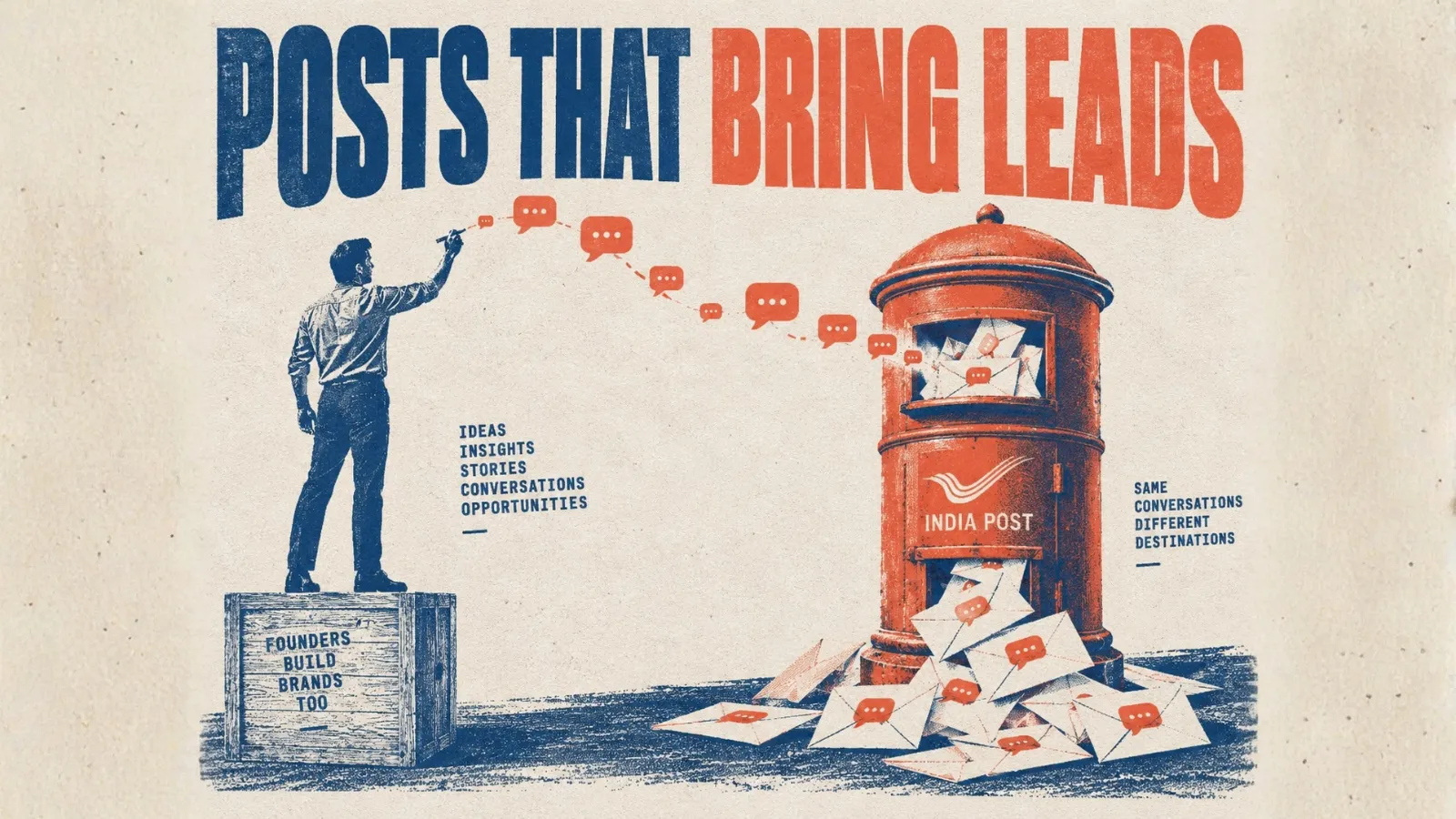
LinkedIn for B2B lead generation illustrated by a founder on a soapbox and a red post box overflowing with inbound messages

How to Use LinkedIn for B2B Lead Generation: A Founder's Playbook

Every B2B founder in India has heard the claim that LinkedIn is where the leads are. And every founder who has posted for six weeks with nothing happening has quietly wondered whether that claim is real.

The honest answer is that LinkedIn for B2B lead generation genuinely works, but not through the tactics most founders try first. Not spraying connection requests. Not pasting the same “10 lessons I learned” post format. Not paid ads alone.

LinkedIn drives real B2B leads when a specific set of things happen together — and when they compound over months, not weeks.

The short answer

LinkedIn for B2B lead generation works when three layers work together: the founder posts consistently in their own voice about the category, the company page reinforces the founder’s authority, and the sales team uses the resulting inbound signals to open warm conversations. Businesses that treat LinkedIn as a channel for building category authority earn compounding inbound demand. Businesses that treat it as a broadcast channel for company updates get politely ignored.

Why LinkedIn is now the default B2B trust surface in India

Five years ago, when an enterprise buyer in Mumbai wanted to evaluate a vendor, they Googled and checked the company website. Today, they Google, check the website, and — the new step — check the founder’s LinkedIn profile.

If the founder is invisible, the buyer wonders what the company is hiding. If the founder posts thoughtfully about the category, the buyer forms an opinion before the first sales call. That opinion often decides whether the call gets scheduled at all.

LinkedIn has moved from “nice to have” to load-bearing infrastructure for B2B founders in India. It is the credibility surface every serious enterprise buyer visits before opening a conversation.

The 3-Layer System for LinkedIn for B2B Lead Generation

Layer 1: Founder authority content

The founder posts two to four times a week in their own voice about the category they operate in. Not company announcements. Real observations, real opinions, real stories from the work.

This is the hardest layer for most founders, but the one that generates the actual inbound signal. A CTO evaluating a SaaS vendor does not remember a company post. They remember a founder’s thoughtful take on a technical challenge they themselves are wrestling with.

Layer 2: Company page reinforcement

The company page publishes structured content that reinforces the founder’s authority — case studies, category thought leadership, customer stories, product depth.

The company page is not where leads come from directly. It is where prospects go to verify that what the founder claims to be building is actually being built. If the page is dormant, the trust breaks.

Layer 3: Sales team activation

The sales team uses inbound signals — profile visits, post engagement, DM enquiries — to open conversations with prospects who have already warmed to the brand. Most founders forget this layer entirely.

When someone likes three of the founder’s posts over a month, they are a warm signal. A sales team that reaches out with context — “I noticed you engaged with our founder’s recent post on X” — closes deals cold outreach never opens.

Why founder content beats company content every time

Company page posts get 200-400 impressions. Founder posts on the same topic get 3,000-15,000 impressions.

The reason is structural. LinkedIn’s algorithm privileges individual voices over company voices. And buyers behave the same way — they trust a person’s opinion more than a brand’s messaging. Companies that hide their founder behind a corporate mask are fighting both the algorithm and the psychology of their buyers.

Five formats that consistently generate leads

These five post formats consistently do the heavy lifting in LinkedIn for B2B lead generation.

1. The category observation post.

A specific observation about how the category is shifting, with a clear point of view on what founders should do about it.

2. The client story post.

A short narrative of a real client engagement — problem, approach, outcome. Anonymised if needed.

3. The contrarian argument post.

A defensible pushback against a widely-held assumption. High engagement, high shareability.

4. The behind-the-scenes founder post.

A specific decision the founder made recently and what they learned. Humanising and credible.

5. The framework post.

A named framework the founder uses. Practical, teachable, remembered.

Founders who rotate all five formats consistently outperform those defaulting to one or two.

What LinkedIn for B2B Lead Generation Looks Like When It Works

For a founder we worked with in the B2B services space, the pattern went like this. Month one — 400 followers, occasional engagement. Month three — 1,800 followers, first inbound DM. Month six — 4,800 followers, six qualified inbound conversations. Month twelve: LinkedIn producing more qualified leads than any other channel including their referral network.

The founder did not become famous. They became known within their category. That distinction matters. B2B lead generation does not require millions of impressions. It requires the right thousand people knowing you exist and taking you seriously.

Similar patterns play out across our engagements with founders in SaaS, consulting and enterprise product companies as documented in our portfolio of B2B work.

Common LinkedIn mistakes B2B founders make

Most founders who give up on LinkedIn for B2B lead generation make at least one of these mistakes.

1. Waiting for perfect posts

Three imperfect posts a week outperform one polished post a month. Every time.

2. Posting company news instead of founder perspective.

“We just raised” is not content. “Here is what we learned in the 18 months before we raised” is content.

3. Outsourcing to a generic content agency.

LinkedIn content written by someone who has never sat in your industry meetings reads like filler. Good ghostwriting requires real time understanding the founder’s voice and category.

4. Ignoring the DMs.

The DM inbox is where actual conversion happens. A founder who posts and never checks messages is missing the point.

How much time this takes

Self-written: 3-4 hours a week. Sustainable for founders who enjoy writing.

Ghostwritten: 90 minutes a week, one 45-minute call where the founder shares raw thinking, plus 45 minutes reviewing drafts and engaging with comments across the week.

Either works. The failure mode is founders who commit to writing themselves, run out of time, post inconsistently and conclude LinkedIn does not work. LinkedIn works. Inconsistency does not.

Frequently Asked Questions

Does LinkedIn for B2B lead generation work in India?

Yes. LinkedIn is where Indian B2B buyers research vendors and the founders behind them. It works best when the founder posts consistently, the company page backs that up, and the sales team follows up on the engagement it creates.

For founders posting consistently in their own voice, first meaningful inbound conversations usually happen in months two to three. The compounding effect where LinkedIn becomes a top lead source typically takes six to twelve months.

Yes, layered on top of a strong organic presence amplifying best-performing organic posts, retargeting engaged prospects, or driving traffic to gated assets. LinkedIn ads without organic authority underneath tend to underperform.

Both, but the founder is the priority. Founder content drives 5-10x the reach of company content. The company page reinforces positioning and provides credibility buyers check next.

Ghostwriting is legitimate and used by most senior B2B founders in India. A good ghostwriter translates the founder’s actual voice, arguments, and expertise into content the founder would have written if they had the time.

LinkedIn is the only platform where the audience is professionally identified, actively researching vendors, and open to business content. For B2B lead generation in India, it is not one of several options, it is the default option.

What next

If you’re a B2B founder in India and want a LinkedIn for B2B lead generation strategy that produces real conversations, not just impressions, reach out to Umanshi.

About the Author

Anirudh Gulati is Digital & Brand Lead at Umanshi Marketing & Branding, shaping brand, digital, growth strategy and building brands for how buyers now discover them: through search, AI and story. He has worked with brands including FashionTV, Astrovigya, Premium Parking & Umenit alongside founders and businesses across technology, healthcare, education and consumer categories.

Anirudh Gulati

Learn From Journal Insights of Umanshi

Ready to find your good place?

Your business is too important to be misunderstood.

Whether you are a Startup proving a concept, an SME breaking a growth ceiling or a Social Enterprise scaling impact, you need visibility that converts.

For Family Businesses and Legacy Brands, we bridge the gap between decades of trust and future relevance to ensure your market perception finally matches your actual value.