
Over the past three years, marketers have faced journey due...
Read More


-
Email
arolax@gmail.com -
Phone
+9 587 325 902 -
Address
Nenuya Centre, Elia Street,
New York, USA
© Alrights reserved
by crowdyTheme
PR and Communication for Temples, Trusts and Religious Institutions in India: A Modern Playbook
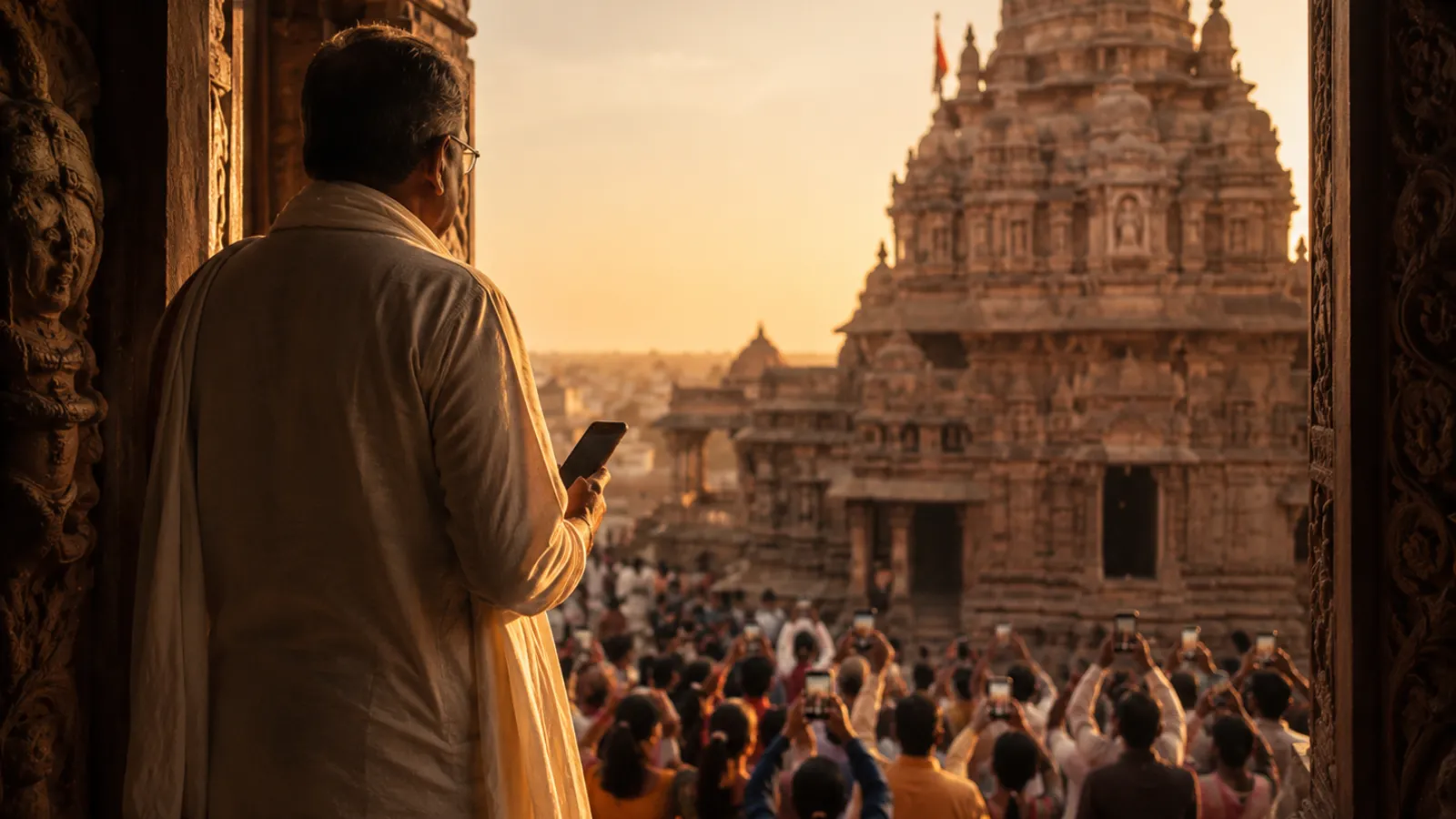
Somewhere right now, a travel creator with two hundred thousand followers is filming a reel inside a sanctum that has stood for six centuries. The lighting is golden, the music is trending, and the caption reads: “Hidden gem — you NEED to visit this.” By morning it will have half a million views. The temple’s trust has no idea it is happening. Neither does the head priest. Nobody asked.
This is the reality of how to promote a temple online in 2026. Except nobody is doing the promoting. India’s religious institutions are getting promoted by themselves — by strangers with a wide spectrum of intentions, from genuine devotion to outright content farming. The result is visibility without accuracy, attention without understanding, and footfall without any of the context that makes a place of worship meaningful.
So here is what spiritual institution communication actually needs to look like, written for the trustees, mahants, administrators, and committees managing India’s temples, trusts and religious bodies.
The short answer
A modern PR and communication strategy for a temple, trust, or religious institution in India does four things at once: it protects the institution’s narrative from being defined entirely by strangers with cameras, it builds donor and devotee trust through transparent communication, it prepares the institution for the crisis communication moments that will inevitably arise during festivals and events, and it ensures that the qualitative depth of the institution — its heritage, scholarship, social infrastructure — is communicated alongside the spectacle that already trends on its own.
Visibility is no longer the problem. India’s religious institutions are not short of attention. They are short of the right kind.
This is the long answer.
The Kedarnath turning point
It is no longer news that the Kedarnath trust has banned the making of reels at the sacred abode, with FIRs filed against those spreading misinformation, provocative social media content, and vandalism — much of it triggered by reel culture itself during the Yatra in Uttarakhand. Between 2023 and 2025, Kedarnath reels went massively viral, including marriage proposals and relationship statuses being confirmed by influencers with the sacred shrine in the backdrop.
India’s religious tourism destinations have always been popular. They are pilgrimage centres, after all. But the offbeat and inaccessible ones are now viral too. And the institutions at the heart of these moments are almost always learning about their own viral status after the fact.
In the era of reels and short-form video, even the most remote shrine in the Himalayas can accumulate an audience overnight. The ghats of Varanasi trend every winter. Drone footage of the Mahakaal corridor goes viral without anyone planning it. Sabarimala, Vaishno Devi, the temples of Madurai — these are not obscure. They are cultural landmarks that the internet has discovered and continues to rediscover, season after season.
The problem is not that religious institutions are unseen. The problem is that they are being seen on everyone else’s terms.
Visibility is not credibility
A viral moment flattens. It turns a complex, living institution into a backdrop.
There is a meaningful difference between a temple trending because a lifestyle influencer called it “India’s most surreal spiritual experience” and that same institution being understood — its historicity accurately told, its living traditions respected and nurtured, its charitable work known and valued.
This is where spiritual institution communication becomes not only useful but the need of the hour. Religious institutions that leave their narrative entirely to strangers — to whatever shows up on social media — are, in effect, outsourcing their identity to whoever happens to be holding the camera.
The PR opportunity here is not about generating more attention. It is about ensuring that the attention already arriving lands on something true, substantive, and worth staying for.
A dharmic institution that has no communication strategy of its own has a lot to lose. Centuries of iconographic tradition behind a murti. Community kitchens that have fed pilgrims daily for decades. A cremation ground that has been burning for centuries. Scholarship programmes run quietly by a trust. Water conservation work. The scaleable economic growth of the village around the institution. None of this trends. And so, to the vast majority of people who now know these institutions through their screens, none of these qualitative dimensions of the institution even exists.
Which institutions need which kind of PR?
Not every religious institution faces the same communication challenge. The strategy depends on the scale and type of the institution.
Tier 1: The major pilgrimage centres
Tirupati, Shirdi, Ayodhya, Dwarka, the Kashi Vishwanath corridor. These institutions already have communications departments, media cells, and government bodies managing their public presence. Their challenge is less about being heard and more about being heard accurately, at scale, across languages and geographies.
For them, temple management is already a sophisticated institutional exercise. What they need is strategic PR that elevates the qualitative — the heritage, the scholarship, the social infrastructure — above the merely spectacular. Today, they are most often covered in media on the basis of footfall numbers alone, not what actually matters.
Tier 2: The mid-tier institutions
A well-regarded math in Karnataka. A trust in Haridwar running a gurukul and a free hospital. An ashram in Maharashtra with a forty-year legacy of classical music preservation. A religious trust in Tamil Nadu managing three temples, a school, and an annadanam programme.
These institutions are not invisible — locals know them, devotees travel for them — but their story exists almost entirely offline. They are deeply vulnerable to misrepresentation, and they have the most to gain from qualitative visibility.
Tier 3: The under-communicated institutions
Small trusts, niche lineages, preservation-focused foundations whose work is significant but whose audience remains limited to those already initiated into their world.
For these, some degree of visibility-building remains relevant. But even here, the goal should be reaching the right people rather than reaching more people.
The four pillars of qualitative PR for religious institutions
A modern PR strategy for a temple or religious trust is built on four pillars. Each one serves a distinct purpose, and together they form a complete communication system.
Pillar 1: Narrative ownership
The institution must decide what it stands for, what it has built, and what it is trying to protect — and then communicate that story consistently. Without this foundation, every other communication effort drifts.
PR for a temple is not a press release about gopuram renovation. It is not celebrity darshan photographs. It is not a hashtag campaign around a festival. It is the disciplined ownership of the institution’s own story.
Pillar 2: Thought leadership from practitioners
This is among the most powerful tools available, and among the most underused. When a trustee or a mahant writes or speaks publicly about temple administration — managing heritage buildings, nurturing living traditions, navigating government oversight, sustaining traditional knowledge systems — they are contributing to a public conversation that today happens largely without their voices.
A dharmacharya who articulates the philosophical principles guiding their institution’s charitable work gives journalists, researchers, and serious seekers something to engage with that no viral reel can provide.
Pillar 3: Strategic media relationships
Not every institution needs a publicist. But every religious institution of significance needs someone who understands how journalists cover religious tourism in India — what they will use, what they will ignore, what they will misrepresent if left without guidance. The relationship between institution and media should be built during peacetime, not during crisis.
Pillar 4: Internal community communication
PR is incomplete if it only looks outward. The institution’s own community of devotees, its local ambassadors, its diaspora — these are the most credible marketers and the most effective word-of-mouth networks.
A newsletter. A WhatsApp channel with verified information. Credible stories placed in trusted news outlets. A temple website design that is accurate, updated, and genuinely useful. None of these are glamorous innovations. They are the very foundation of controlling the narrative.
The donation debacle
One area where the visibility-credibility gap has direct financial consequences is in giving.
The Indian diaspora has deep emotional ties to temples and lineages back home. The appetite to contribute is real. But trust — specifically, confidence that donations are being used well and transparently — remains the single biggest barrier.
An online donation platform for temples solves the logistics. It does not solve the trust deficit.
What solves the trust deficit is consistent, transparent communication: annual reports published and shared, project updates sent to donors, photographs of the annadanam hall that their contribution helped build, named outcomes from scholarship programmes. This is where religious trust management has the most ground to make up, and where good communication directly translates into sustained institutional health.
Organising a religious event that does more than trend
Festivals and events present religious institutions with their clearest communication opportunity — and their most commonly misinterpreted one.
A Kumbh camp managed with genuine efficiency and spiritual depth will be talked about for decades — but only if someone is capturing it with intention, not just chasing content that trends because of controversy.
And there is a dimension of religious events that almost no religious institution thinks seriously about: crisis.
The crisis communication gap
Stampedes. Fires. Deaths from heatstroke or crowd crush. Clashes between two groups with competing claims over a procession route. A health emergency in a pilgrim camp.
These are not hypothetical scenarios. They have occurred at some of the most revered sites in the country — at Haridwar, at Tirupati, during major Kumbh gatherings, at local festivals across states.
In almost every instance, the pattern is the same. The crisis happens. Footage spreads within minutes. Rumours multiply. Fear travels faster than any official statement. And the institution — the trust, the temple board, the organising committee — goes silent.
Not always out of negligence. Often out of genuine unpreparedness.
There is nobody whose job it is to speak. No designated spokesperson who can step in front of a camera and say, calmly and clearly, what has happened, what is being done, and what devotees should do next. No protocol for when to call the press, what to say, and — equally important — what not to say while facts are still being established.
While religious events seek clarity of communication, documentation, event highlights, and correct interpretation of the moment, it is in the face of eventualities that clean, clinical, professional communication support is most needed.
What a crisis-ready religious institution actually has in place
Before any crisis, a well-prepared institution has these five things ready:
1. A designated spokesperson. Usually a senior administrator or trustee with clear authority to speak on behalf of the institution.
2. A pre-agreed escalation protocol. Who decides what gets said, who manages internal communication, who liaises with police and emergency services, who handles media.
3. Established peacetime media relationships. Journalists who already know the institution, already have context, and will report responsibly during a moment of pressure.
4. Templated holding statements. Drafted in calm moments, ready to be adapted in the first 30 minutes of any crisis.
5. A clear documentation discipline. Photographs, official accounts, sequence of events captured by the institution’s own team — so the institution is not entirely reliant on others’ footage to establish what happened.
The institutions that have done this work navigate difficult moments without reputation damage. The institutions that have not done this work tend to learn the cost of unpreparedness the hard way.
Frequently asked questions
What is the most important first step for a temple or trust starting PR work?
The first step is narrative clarity. Before any media outreach, the institution must articulate clearly what it stands for, what it has built, and what makes it distinct. Without this foundation, every other communication effort drifts.
Does a religious institution need a full-time PR team?
Most do not. A mid-tier trust or temple can operate effectively with a designated communication lead internally and an external agency or advisor providing strategic support, media relationships, and crisis preparedness.
How does PR help with donor trust?
PR builds donor trust by making the institution’s work visible, transparent, and verifiable. Annual reports, project updates, named outcomes from charitable programmes, and credible third-party media coverage all reinforce the confidence that donations are being used well.
What kind of content should a temple share on digital platforms?
Authentic and substantive content. Heritage explanations, scholarship updates, charitable work, festival documentation done with intention, and educational content about the institution’s traditions. Not viral-chasing content that flattens the institution into a backdrop.
How should a religious institution prepare for a crisis?
By designating a spokesperson, building peacetime media relationships, drafting templated holding statements, agreeing an escalation protocol, and maintaining a documentation discipline. The work happens long before the crisis arrives.
The bottom line
India’s temples, trusts, and spiritual institutions are not short of attention. They are short of the right kind. The reels will keep coming, the footfall will keep growing, and the algorithms will keep surfacing whatever is most visually striking, most emotionally immediate, most shareable.
What will not happen automatically is accuracy. Depth. The communication of what these institutions have actually built, what they protect, what they are trying to pass on.
That requires intention. It requires someone, within the institution or working closely with it, who understands that the goal of communication is not more noise — it is the right signal, reaching the right people, at the right moment.
The audience is already there. The question is what they find when they look a little closer.
If you are a trustee, mahant, administrator, or senior leader at a temple, trust, or spiritual institution and want a candid conversation about how to take ownership of your institution’s narrative, reach out to our team for a consultation. Confidential, structured, and built around the unique communication needs of dharmic institutions in India.
Because in this category, the right communication does not just earn attention. It earns the trust that lets centuries of work continue.
Learn From Journal Insights of Umanshi

LinkedIn for B2B Lead Generation: Proven 3-Layer Playbook
Over the past three years, marketers have faced journey due...
Read More
Brand Identity for Small Businesses and Startups: 4 Proven Steps
Over the past three years, marketers have faced journey due...
Read MoreReady to find your good place?
Your business is too important to be misunderstood.
Whether you are a Startup proving a concept, an SME breaking a growth ceiling or a Social Enterprise scaling impact, you need visibility that converts.
For Family Businesses and Legacy Brands, we bridge the gap between decades of trust and future relevance to ensure your market perception finally matches your actual value.
