Your Website is Bleeding Money — and You Might Not Even Know It
Most founders/ businesses we speak to have grown their business through hustle, networks, referrals, offline relationships and strong product-market fit… not their website.
And that’s exactly why the website gets ignored.
After all, if business is coming in anyway, why bother?
Here’s the part most people miss:
A website doesn’t just bring sales. It influences them.
It reinforces trust.
It accelerates conversations.
It qualifies leads.
It reduces friction for your sales process/ team.
It tells your story the way you want it told — without you being in the room.
Your company has evolved. You’ve launched new services, landed bigger clients and refined your positioning. Yet, your website is still telling your old story.
BTW , even if you’re in B2B and your website isn’t your primary sales engine, it is still impacting your pipeline more than you think — positively or negatively.
Let’s talk about the real leaks we see in over 90% of websites — especially in growing companies and how we help plug them.
The 5 Major Money Leaks (And How We Plug Them)
We’ve audited hundreds of sites. These are the five most common—and costly—issues we find.
Leak #1: Your Business Has Evolved. Your Website Hasn’t.
Most founders relate to this instantly.
Your offerings changed, your positioning matured, you added new services, expanded geographies, hired better people… but your website still reflects a version of your company from 4 years ago.
When your business outgrows your website, three things happen:
- Buyers don’t fully understand what you do now.
- You lose credibility before the first call even happens.
- Your sales team spends most of their time “correcting” the website narrative.
In B2B, this hurts pipeline quality more than anything else.
What founders usually say:
- “Our prospects assume we’re smaller than we actually are.”
- “People still think we do X, but we now specialize in Y.”
- “Our website doesn’t reflect our capabilities.”
How we fix it:
We realign your website with your current business, not the older version the web still shows.
That means a fresh narrative, updated service architecture, clearer messaging and a positioning that reflects who you are today.
Bangalore Softsell – B2B
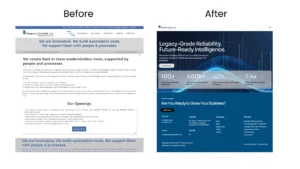
Leak #2: Your Website Doesn’t Support Your Buying Cycle
This is a big one — especially for B2B.
Most websites talk about the company.
But buyers care about:
- Their problem
- Their risk
- Their timeline
- Their next step
A lot of founders think the website doesn’t generate sales because “buyers prefer calls.”
What they don’t see is that the website is influencing decisions before and after every call.
If the site doesn’t help them move through the buying cycle — awareness → evaluation → trust → decision — they will delay, drop off or choose a competitor who looks more mature.
Reactions from businesses, we hear:
- “Our leads take too long to decide.”
- “People don’t understand our process or pricing.”
- “Prospects ghost after the first call.”
That’s not always a sales problem.
That’s a website support problem.
How we fix it:
We build pages and content that guide your buyer:
- Clear “Why us?”
- Case studies aligned with their scenario
- Simple service flows
- Trust markers
- Industry specificity
- Pages answering questions sales teams handle repeatedly
Your website becomes a silent sales assistant — supporting your pipeline, not sitting as a passive brochure.
Inquitizy – B2B
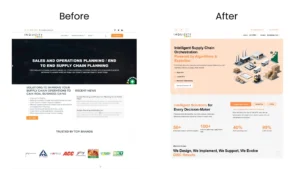
Leak #3: “Looks Good, Works Bad” — The Pretty-But-Useless Trap
Many businesses do a revamp thinking design will fix everything.
But if the UI looks premium while the UX confuses people, you end up with a site that is:
- Hard to navigate
- Heavy, fancy and complicated
- Visually appealing but practically useless
- Full of clutter and zero direction
This is where credibility goes to die — no matter how good your product/ offering is. This happens in B2B as well as B2C where buyers expect clarity, ease and professionalism.
What founders tell us:
- “We just redesigned it last year… why isn’t it performing?”
- “People land but don’t take any action.”
- “Our site feels confusing even to us.”
The impact:
Confusion kills conversions.
And it kills trust faster than anything else.
How we fix it:
- We redesign with intention.
- Not “more colors, more icons, more animations.”
- But structure, flow, readability and a clear path for every visitor.
Sampusht Aaharam – D2C
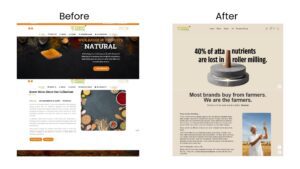
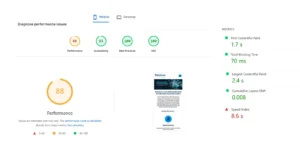
Leak #4: Your Website Is Paying the Speed Tax
Google calls it out clearly:
- If your page load jumps from 1s to 3s, bounce probability increases by 32%.
So speed is no longer a technical topic.
It’s a business topic.
Slow site = higher drop-offs, lower trust and poorer SEO visibility.
Even in B2B, your buyer subconsciously equates speed with reliability.
And nobody waits anymore — not even corporate decision-makers checking your site between meetings.
What businesses notice:
- “The site feels heavy.”
- “Our rankings are flat.”
- “People don’t scroll much.”
How we fix it:
We focus on the Core Web Vitals that matter:
- LCP (how quickly the main content appears)
- TBT (how long the page is blocked before it becomes usable)
- CLS (how stable the page feels while loading)
Plus optimizations that boost business impact:
- Image compression
- CDN
- Code cleanup
- Render-blocking fixes
- Better hosting
This alone has improved conversions for several clients — even without touching the UI.
Mobile optimization is also part of this.
Over 60% of traffic comes from mobile devices.
If the mobile experience feels broken, credibility drops instantly.
Percivon – B2B
Leak #5: Your Website Isn’t Evolving With Industry, Design or SEO
Your business evolves.
Your market evolves.
Your buyers evolve.
But a lot of websites stay frozen.
Two common scenarios:
- The site is 3–5 years old and feels outdated.
- The site was made recently, but without awareness of current UX, SEO or industry best practices.
Both cause the same problems:
- Outdated language
- Old-school layouts
- No structured content
- Unoptimized pages
- Missing conversions
- Poor rankings
- Weak trust signals
Founders often say:
- “We’re not ranking even for branded searches.”
- “Our competitors look more modern.”
- “Our website doesn’t represent the company we’ve become.”
How we fix it:
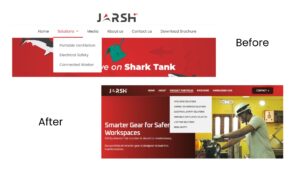
We upgrade your site to match today’s expectations:
- Updated UX patterns
- Modern layouts
- Better content architecture
- SEO-structured pages
- Better messaging
- Clearer positioning
You get a site that feels current — not outdated — and one that actually supports your sales efforts.
Jarsh – B2B
So… Do You Really Need a Redesign?
Maybe. Maybe not.
Most companies don’t need a fancy overhaul.
They need a strategic, business-aligned correction.
A few targeted fixes can:
- Improve credibility
- Shorten your sales cycle
- Increase lead quality
- Support the buyer journey
- Reduce friction for your sales team
- Bring clarity to your offering
- Increase conversions quietly, consistently
Your website is not a cost.
It’s an asset — if built right.
If it isn’t helping your business, it’s silently hurting it.
Ready to Stop the Bleeding?
If you want, we can run a Website Revenue-Leak Audit for you.
It’s fast, founder-friendly and gives you the exact fixes that’ll improve pipeline and conversions — without unnecessary spending.
FAQ Section
FAQ 1: How do I know if my website is affecting my sales pipeline?
If prospects visit but don’t enquire, ask repeated questions your site should answer or drop off after the first call, your website isn’t supporting the buying cycle. A quick funnel and user-flow audit will reveal where the friction lies.
FAQ 2: Do B2B companies really need an updated website?
Yes. Even if your sales come from relationships or referrals, buyers still check your website before deciding. A dated or unclear site reduces trust, slows decisions and makes your business look smaller than it actually is.
FAQ 3: What’s the fastest improvement I can make without a full redesign?
Start with clarity and speed. Update your key pages with current offerings, fix confusing navigation, improve load time and simplify CTAs. These small changes often lift conversions without touching the entire design.
FAQ 4: Why does website speed matter if my customers buy through sales calls?
Speed influences trust. Even B2B buyers judge reliability based on how fast your site loads. Slow pages increase drop-offs, hurt SEO visibility and create a poor first impression — often before your sales team even gets involved.
FAQ 5: How often should a business update its website?
Every 12–18 months, not necessarily with a redesign — but with improvements to content, structure, industry positioning and UX patterns. Trends, user expectations and search algorithms evolve quickly, and your site should too.